
CERAMIC TILE TESTING
Whether you’re a designer, manufacturer, supplier or builder, our ceramic tile testing services provide reliable data and relevant insights for the benefit of your product or project. We provide comprehensive testing of ceramic tiles, including tiles for use on pedestals (pods).
Determining suitability for project use
With our ceramic tile testing and evaluation services, you can gain valuable data to determine the suitability of your tile for its proposed uses. Test programs can be compiled from a wide range of tests conforming to Australian standard procedures.
Work with us from the selection of the ceramic tile, right through to use of the tile at the project level and beyond. We perform ceramic tile tests for manufacturers and projects in Adelaide, Sydney, Melbourne, Brisbane, around Australia and internationally. Samples can be sent to our NATA-accredited lab here in Adelaide.
Are the tests for ceramic tiles different to stone?
Ceramic tile test methods are tailored specifically to ceramic, mainly due to the different characteristics of ceramic compared to stone. Generally, the heat of drying is often higher with ceramic, and the length of time conditioning is often different, depending on the test. Testing is often more aggressive for ceramic than it is for stone due to the durable nature of the manufactured product compared to natural stone.
Ceramic Tile Testing
Tests relevant to ceramic tile
Water absorption, apparent porosity, apparent relative density & bulk density - AS ISO 10545.3:2020
Water Absorption method determines the key physical properties of ceramic tiles, focusing on how porous the material is and how it interacts with water, by measuring:
- Water Absorption (% by weight) - how much water the material can absorb when fully saturated
- Apparent Porosity (%) – the percentage of open pores in the material -> the tiny holes that can fill with water
- Apparent Relative Density (g.cm-3) – how dense the solid portion of the material is -> excludes the open pores
- Bulk Density (g.cm-3) – how dense the overall material is -> including the open pores
Why is the Water Absorption of ceramic tiles important?
Water Absorption ceramic test method is the key test for ceramic tiles as it determines which Group Classification the tile falls under (see section below for more information on Group Classifications). We can then determine if the tile complies with the specification of the Group Classification for dimensional and surface quality requirements, physical properties and staining or chemical properties. The Group Classification, along with the unique requirements of a particular project and the needs of the client, together influence which tests need to be performed.
The water absorption of ceramic tiles is tested to AS ISO 10545.3:2020 “Ceramic Tiles – Method 3: Determination of water absorption, apparent porosity, apparent relative density and bulk density.” A standard number of specimens (which is determined by the size of the full tile) are dried to constant mass at 110 degrees C for a minimum of 24 hours and then cooled to room temperature. The specimens are weighed dry before being placed within a vacuum chamber, evacuating the air and slowly admitting water to fully immerse the specimens. The specimens remain submerged in the water under vacuum for 15 minutes before they are weighed soaked after patting excess water from the surface with a damp microfibre cloth. They are also weighed suspended in water. The water absorption, expressed as a percentage of the dry mass, is calculated using the dry weight and the soaked weight of the specimens. The suspended weight is used to determine the density.
Modulus of rupture and breaking strength – AS ISO 10545.4
Modulus of rupture and breaking strength ceramic test method determines bending (flexural) strength by applying a force to the centre of the tiles at a specified rate until failure, measuring both:
- Breaking Load (N) – the force necessary to cause the individual test specimens to break.
- Mean Breaking Strength (N) – The amount of force a material can handle per unit area before it breaks. The breaking strength is obtained by multiplying the breaking load by the ratio of the span to the width, it is NOT the ultimate failure load of the full-size tile.
- Mean Modulus of Rupture (MPa) – the materials bending (flexural) strength (how much the material can bend before it breaks)
Impact resistance (by measurement of coefficient of restitution) – AS 4459.5
Impact resistance ceramic test method determines how well the surface is resistant to impact by dropping of a steel ball, measuring the:
- Coefficient of Restitution (CoR) – ratio of rebound to the height of the dropped steel ball (how much energy is retained after impact to the surface)
- Cahir level (0-5) – a rating system of how resistant the material is to damage (additional included information - not part of standard test method)
- Description of Damage – the type of damage visible on the surface after testing.
Resistance to thermal shock – AS ISO 10545.9
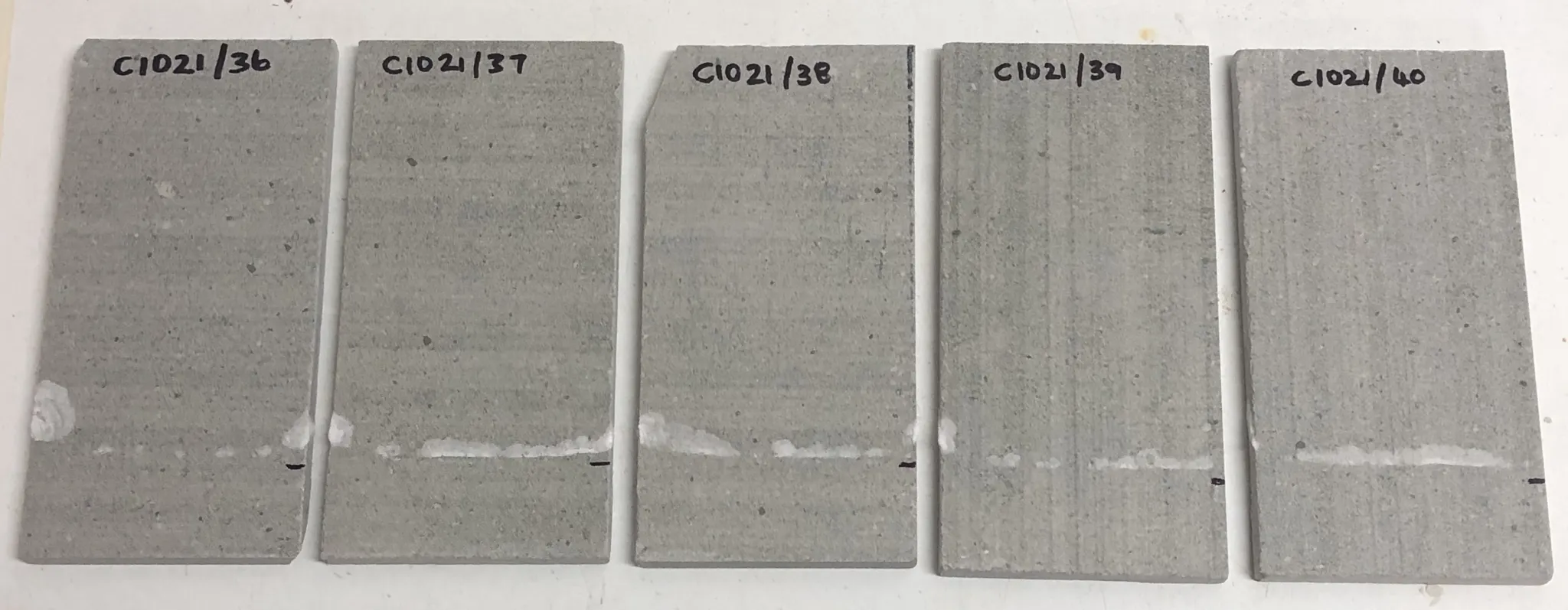
Resistance to thermal shock determines the materials ability to withstand rapid temperature changes, by repeatedly exposing the tiles to hot and cold temperatures, then evaluated for visible defects such as:
- cracking
- delamination
- material detachment
- other surface defects
Frost resistance – AS ISO 10545.12
Frost resistance determines the durability of the material after constant freeze-thaw cycling, by water-saturated samples being frozen and then thawed repeatedly, followed by a visual examination to determine if any damage occurs to the surface or edges of the tiles. This test method is often used to access suitability for cold climates where absorbed water can expand and cause cracking.
Chemical resistance – AS 4459.13
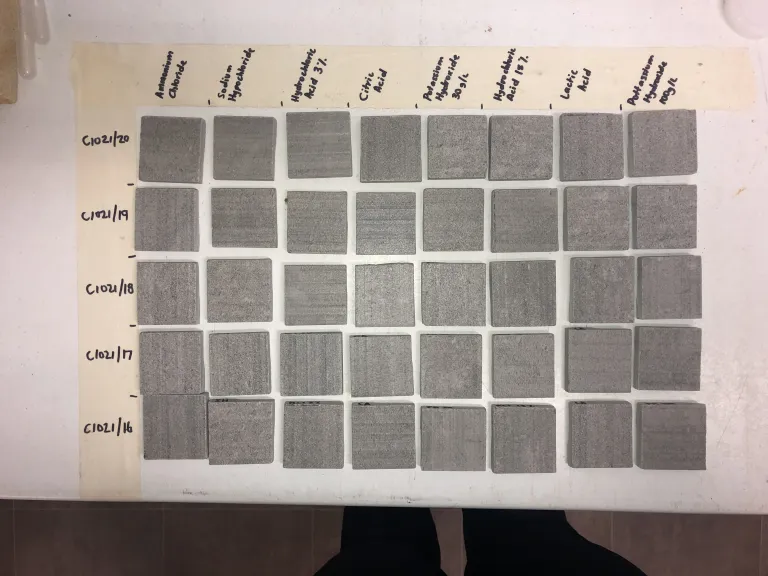
Chemical Resistance is tested to evaluate how the material will respond to prolonged exposure to a range of house chemicals, acids & alkalis, then assessed for discolouration, etching, loss of finish or other surface damage. This test method is critical in determining how the material will perform in locations where it is regularly exposed to aggressive substances such as:
- Kitchens/bathrooms -> food acids and/or cleaning products
- Commercial spaces -> frequent cleaning with strong chemicals
- Swimming pools -> chlorinated or saltwater exposure
- Industrial -> potential contact with harsh stronger chemicals
The chemical resistance result is reported as:
- Determination of Class – classification assigned following the relevant evaluation procedure.
Note: The evaluation procedure depends on the tile type (glazed or unglazed), which determines how the assessment is carried out.
Resistance to stains – AS 4459.14
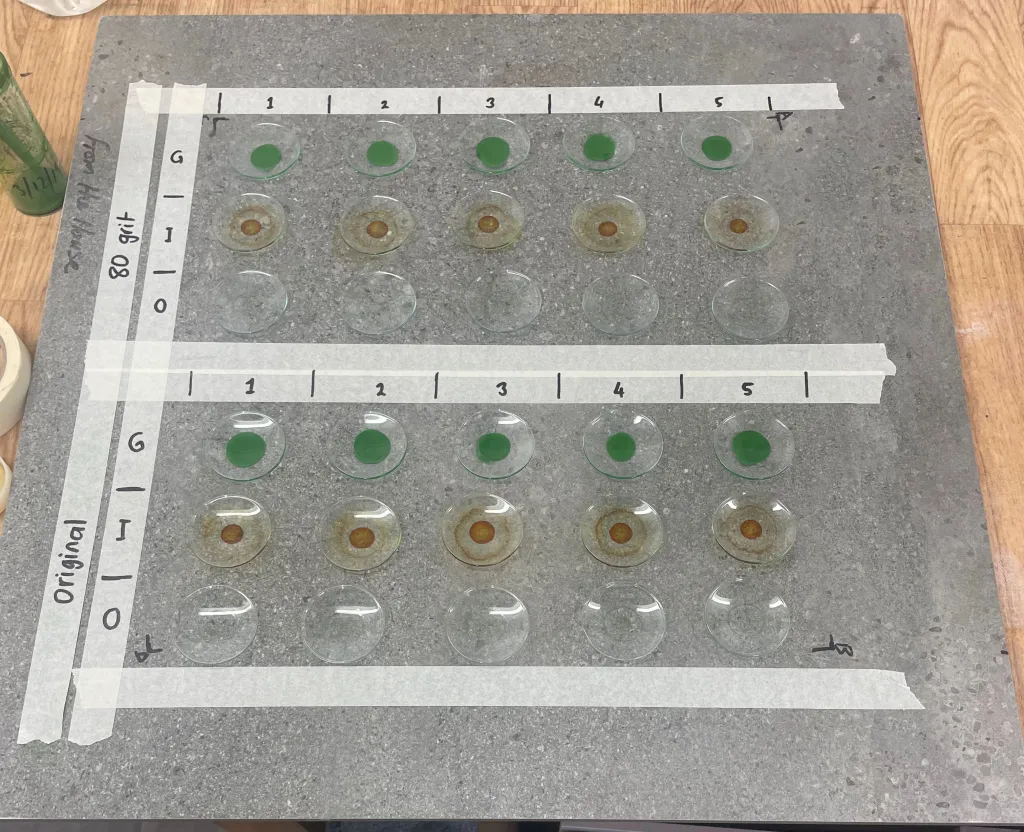
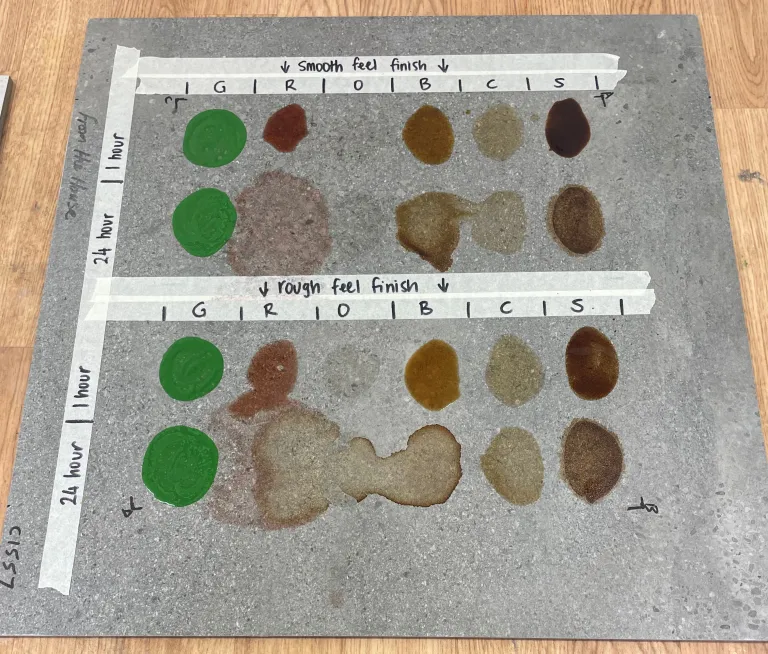
Resistance to staining of ceramic tiles evaluates how easily substances can penetrate the materials surface and how easily they can be removed. The results provide an indication of ease of cleaning (cleanability), potential need for sealing and overall fitness for purpose.
This test method determines the resistance to staining by maintaining test solutions and the material in contact, then subjecting them to defined cleaning procedures in attempt to remove the stains. The surface is then visually examined for any residual markings or change in appearance, results are reported as:
- Classification (1-5) – a scale of how easily the staining agent was removed after the defined cleaning procedures (e.g. oil was completely removed following cleaning procedure ‘A’, therefore would be given a ‘Class 5’ classification).
This test method is critical in determining how the material will perform in locations where it is regularly exposed to potential staining substances such as:
- Benchtops & joinery -> high risk of exposure to oils, acids or grimy substances
- Flooring -> particularly high-trafficked areas
- Commercial spaces -> where spills are more frequent
Stain resistance (in-house test method) – full method coming soon
Small colour difference – AS ISO 10545.16
Small colour difference test method measures the colour consistency between tiles and/or batches, which are designed to be of uniform and consistent colour.
Slip resistance – AS 4586 & AS 4663
Slip Resistance testing measures the slip resistance of ceramic tile surfaces under dry and/or wet conditions to determine their suitability for pedestrian areas. AS 4586:2013 Slip resistance classification of new pedestrian surface materials is typically used to classify new tiles using methods such as wet pendulum or dry floor friction testing, while AS 4663:2013 Slip resistance measurement of existing pedestrian surfaces is used to measure slip resistance on installed surfaces.
Slip resistance is a key safety parameter for floor tiles, especially in wet or high-traffic areas such as bathrooms, kitchens, commercial spaces, and outdoor walkways determined by measuring the:
- British Pendulum Number (BPN) – the individual result of each test site during the pendulum test method.
- Slip Resistance Value (SRV) – the mean measurement of the 5 required BPN results to determine how slip resistant a tile surface is.
- P-Rating – classification system derived from SRV results (for new pedestrian surface only)
- Suitable locations – a guide to the location suitability of the tile according to HB198.
Find out more about slip resistance (link to slip page)
Slip resistance after accelerated wear – SI-AWT
Slip Resistance after accelerated wear evaluates how the slip resistance of ceramic tiles changes after simulated long-term wear. The tile surface is subjected to controlled wear processes that mimic the effects of traffic, routine cleaning and general wear over time, after which slip resistance is then re-measured.
For ceramic tiles, this test is useful for textured or coated surfaces that may lose their slip-resistant properties. By assessing slip resistance after accelerated wear, the test provides an indication of how well the tile is likely to maintain safe traction throughout its service life, helping designers and specifiers select tiles that may remain compliant.
Find out more about slip resistance after accelerated wear HERE.
Abrasion resistance – AS ISO 10545.6 (Unglazed tiles) & AS ISO 10545.7 (Glazed tiles) – Coming soon
Ceramic water absorption test explained
The water absorption test is important for ceramic tiles because it is what determines which Group Classification the tile falls under (see section below for more on Group Classifications). We can then determine if the tile complies with the specifications of this Group Classification for dimensional and surface quality requirements, physical properties, and chemical properties. The Group Classification, along with the unique requirements of the job and the needs of the client, together influence which tests need to be performed.
The water absorption of ceramic tiles is tested to AS ISO 10545.3:2020 “Ceramic Tiles – Method 3: Determination of water absorption, apparent porosity, apparent relative density and bulk density.” A standard number of specimens (which is determined by the size of the full tile) are dried to constant mass at 110 degrees C for a minimum of 24 hours. The specimens are weighed dry before being placed within a vacuum chamber, evacuating the air and slowly admitting water to fully immerse the specimens. The specimens remain submerged in the water under vacuum for 15 minutes before they are weighed soaked after patting excess water from the surface with a damp microfibre cloth. They are also weighed suspended in water. The water absorption, expressed as a percentage of the dry mass, is calculated using the dry weight and the soaked weight of the specimens. The suspended weight is used to determine the density.

“Testing ceramic tiles is essential because it verifies how the product will perform in real-world conditions, particularly in terms of durability, safety, and compliance with Australian Standards. In practice, we often find that overseas test data can be outdated, not aligned with local requirements, or not truly representative of the specific tiles being supplied, which can introduce unnecessary risk if relied on in isolation.
At Stone Initiatives, we’re not only specialists in natural stone, we also have extensive expertise in ceramic tiles and other engineered products. That broader capability allows us to provide material-specific, independent assessments that give designers, builders, and manufacturers confidence that the product is fit for purpose before it is installed.”
Kate Tonkin
Co-Director, Materials Testing Specialist – Finishes Evaluation & Slip Resistance Specialist
Ceramic and porcelain tile classifications
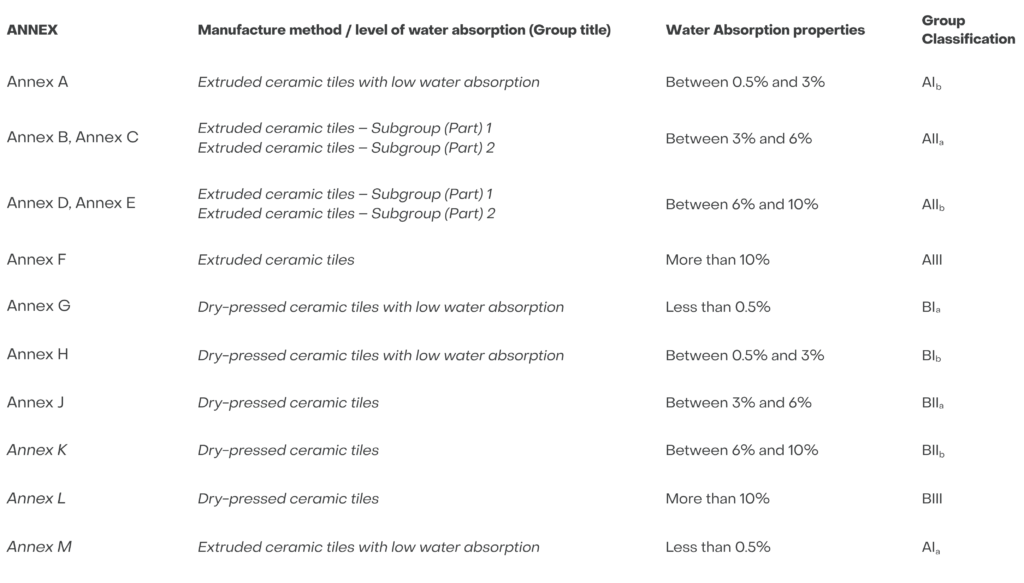
Ceramic and porcelain tiles are classified by AS 13006:2020 (ISO 13006:2018) “Ceramic Tiles – Definitions, classification, characteristics and marking.” The ceramic tile is given a Group Classification, which depends on the method of manufacture of the tile and the water absorption properties.
Every ceramic tile, including those sourced internationally, is required to have its Group Classification specified on the packaging, or sometimes the Annex letter is written on the box as well as or instead of the Group Classification. Other information that should be included on the packaging are the manufacturer’s mark or trademark and the country where the tile was manufactured, the nature of the surface, i.e. glazed (GL) or unglazed (UGL), nominal and work sizes and “M” if modular, any surface treatment applied after firing and the total number of tiles in the package.
This information is important to know because it can help us determine which tests are relevant for the specific tile product. For tests such as stain and chemical resistance, it is important to know the nature of the tile surface – if it is glazed or unglazed, or if it has had any treatments applied to it after firing. In an instance where a client is having issues with a tile, we can complete a water absorption test in our lab to understand if the tile has been classified properly.
Below is a table showing the Group Classifications, plus the manufacturing method and water absorption requirement for each group classification. The Annex refers to the part of ISO (AS) 13006 that specifies the other property requirements for each classification/group of ceramic tile.
LEARN MORE
Frequently asked questions
What is the difference between porcelain and ceramic?
Porcelain is a type of ceramic. Porcelain is fired at a different temperature and duration to traditional ceramics, and the composition of the source clay used to produce porcelain is also commonly different. Porcelain is typically identified as a Group BIa classified ceramic due to its very low water absorption properties.
Testing porcelain and other ceramic tiles on pedestals (sometimes called pods)
The use of pedestal systems for porcelain and other ceramic tiles can provide benefits such as reduced installation time, easier access to services, and benefits to drainage. However, there are also drawbacks and risks associated with pedestal systems, particularly when porcelain is involved. These include the risk of pedestrians falling through when a tile breaks and subsequent injuries, plus the cost of replacing broken tiles.
The main tests recommended for porcelain tiles on pedestals
- Stone Initiatives method SI-CLCP – tests the concentrated static load capacity of the porcelain tiles while installed on a particular pedestal system.
- British Standard method BS EN 14158:2004 (modified) – tests the impact rupture energy of the material.
- Australian Standard AS ISO 10545.3:2020 – determines the water absorption capacity and density of the tile.
- Australian Standard AS ISO 10545.4:2020 – determines the modulus of rupture and breaking strength of the tile.
- Australian Standard AS 4586:2013 – determines and classifies the slip resistance of the surface of the tile.