
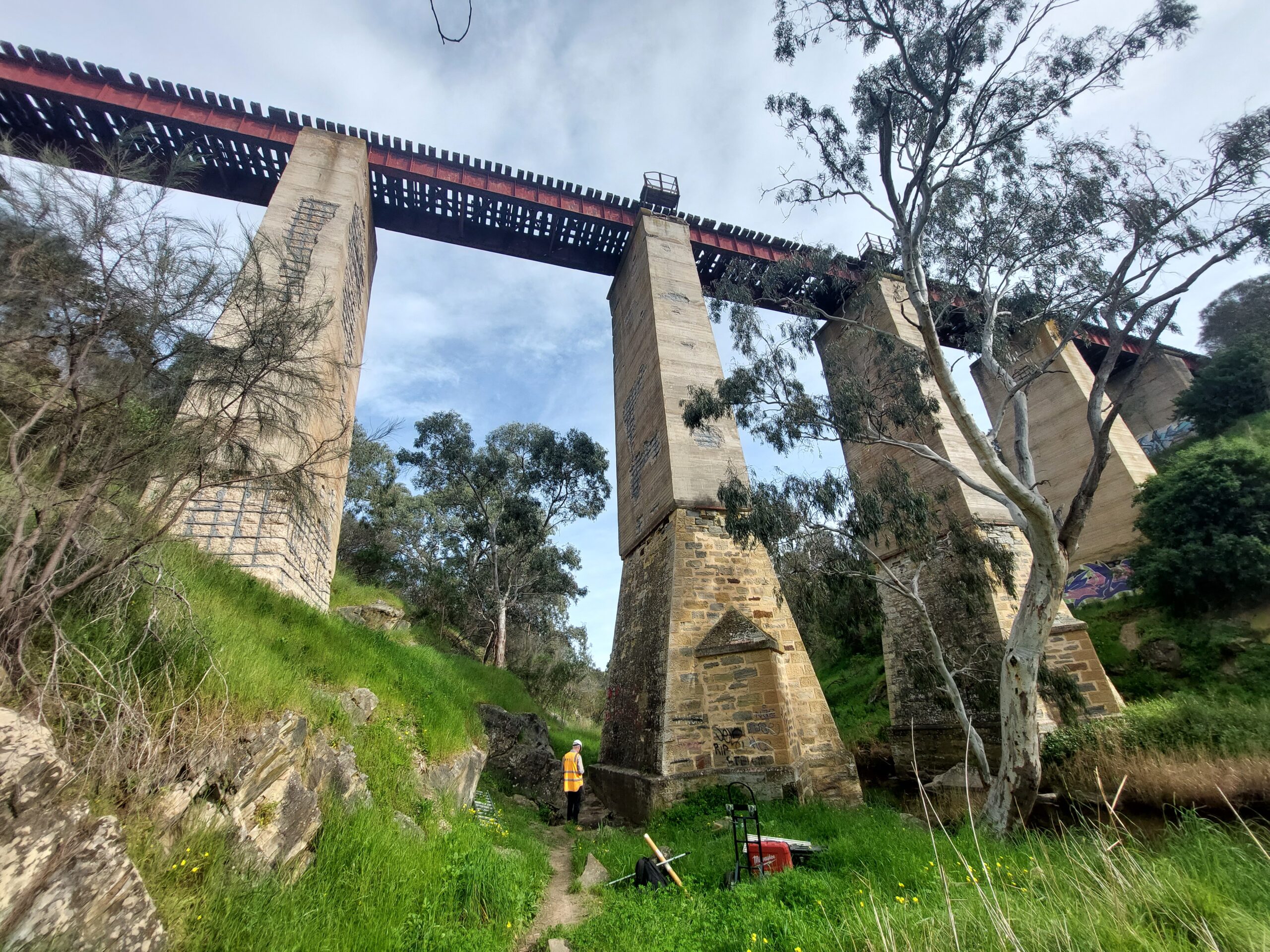
Stone Initiatives has provided analytical heritage services for the restoration of a 157-year-old railway viaduct located in the South Australian township of Currency Creek. Engaged by AECOM, Stone Initiatives carried out testing and analysis to inform the repair of the viaduct’s piers, including identification of original stone types, compositional analysis of buttresses and mortar analysis.
With base piers constructed primarily from bluestone rubble and sandstone quoins, the Currency Creek Railway Viaduct was completed in 1867 to carry a horse-drawn tramway and is listed as a State Heritage Place. It is said to be the tallest rail bridge in South Australia.
“It’s fascinating observing the skill and craftsmanship of a finished product that has stood the test of time,” says Mark Milevski.
Remediation works being undertaken by the Department for Infrastructure and Transport involve repairs to the bridge stonework, masonry, piers and concrete surfaces to ensure long-term structural integrity and safety.
Identifying the original stone
The analysis revealed the piers were made of random rubble face stone, using a local Kanmantoo Group bluestone. They also had dressed sandstone quoins, using a local fine-grained glacial sandstone. The sandstone was most likely extracted from one of the historic quarries at Finniss River, about 30 kilometres from the bridge, while the bluestone was likely sourced from a historic quarry face about 50 metres downstream of the bridge.
“As is typical for most heritage builds, local materials were used where possible,” says Mark.
Compositional analysis
Another element of the work was determining the internal composition of a buttress. This was achieved by drilling with a masonry bit through the joints in the external stonework to a maximum depth of 800mm. Samples of the drilling debris were collected from various depths and locations and analysed by X-Ray Diffraction to determine the mineral composition.
To assist the project team in carrying out repairs with like-for-like materials, samples of render, mortar and concrete were also collected for compositional analysis.
Currency Creek Viaduct Restoration
Year:
2024Stone consultant:
Stone InitiativesScope:
On-site and laboratory analysis prior to restoration worksClient:
AECOM Australia Pty LtdWorks undertaken by:
Department for Infrastructure and TransportHeritage architect:
Swanbury PenglasePhotography:
Mark MilevskiService type:
Heritage Assessment